Celebrate July 4th with a 10% Independence Day discount! Use coupon code — JULY4QC2024! 🤩
-p-130x130q80.avif)

.svg)


Let’s say you have bought a new video game and you don’t know how to connect it to your PC. What do you do now? The first thing that comes to your mind is to check Google, ChatGPT, or YouTube. Most people prefer video-based explanations over text content. Statistically, 82% of the users prefer video support in 2026. Also, studies show that visuals can be understood 60,000 times faster than text.
Static documentation is the traditional way of sharing knowledge through PDFs, articles, guides, and FAQs. While these are necessary for understanding how a product works, it is not the most preferred mode for users now-a-days.
A video knowledge base uses short walkthrough videos of how to do certain tasks, product demos, and embedded videos that guides users visually.
People prefer video knowledge base over static documentation. But why? Let’s get to know the psychology behind this.
It’s because the cognitive load created by video knowledge base is less when compared to static documentation. Cognitive load is the total amount of mental effort and memory resources required to process information or a task by the brain. Lower the cognitive load, the easier it is for a person to process, understand and retain the information.
When a person tries to understand something through a text-based documentation, the person gets to process the information, connect the ideas, interpret what has been said, and then perform the action, which leads to higher cognitive load. Whereas in video learning the cognitive load is lower as it uses the visual and sensory channels simultaneously, making it easier to decode the entire process.
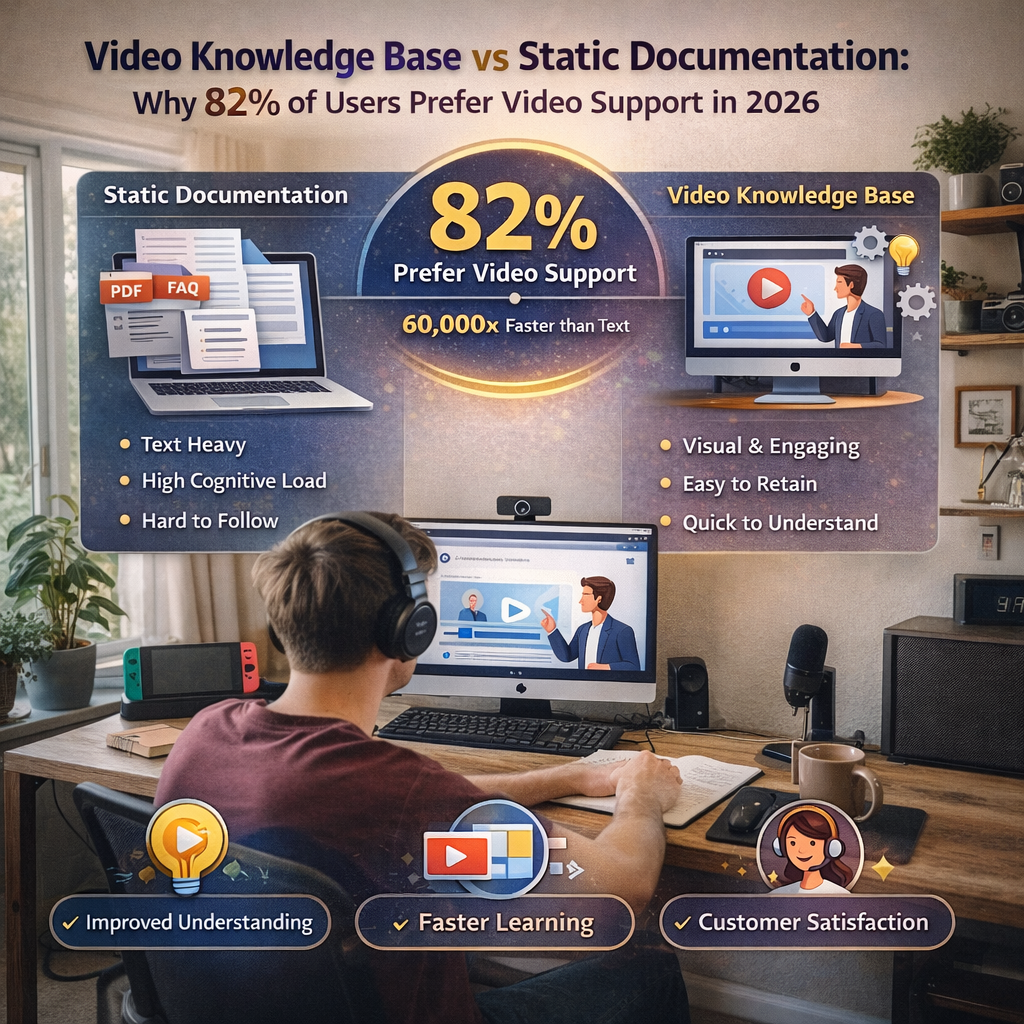
Image generated by ChatGPT (OpenAI, 2026)
A short answer to this is Yes, but it doesn’t mean that static documentation can be avoided completely. Static documentation is also essential as it provides in-depth knowledge about the product. It allows quick keyword searches and offers ease of maintenance. It also has the ability to accommodate the tiniest details to the most exhaustive information. However, video learning offers ease of understanding. Therefore, a hybrid approach of integrating video support into your documentation should ideally be considered.
When a feature of your product is explained to your users in an explainer video instead of a text documentation, they don’t have to read the entire document. They can just perform the actions that are being demonstrated in the explainer video. The visual cues simplify understanding and product adoption.
Visual information is retained better than text. The retention rate for visual information is said to be 80%, while the retention rate for text-based information rarely exceeds 50%. Video tutorial combines visual (related images, animations) and auditory elements (spoken explanations), making it easier for information retention.
When users receive related visuals and audio simultaneously, rather than the user just reading the text, it grabs their attention and keeps them engaged. Video support lets users to perform actions as the video plays, this keeps them attentive and helps them stay focused for a longer time. They can also replay specific sections if they need more clarity. The dynamic background music, audio explanations in conversational tone, visuals like animations and images help in serving this clarity.
In video tutorials, it is easy for users to follow up and understand the product better in less time. The users can just follow along the video guide that shows what to do, so that the users don’t feel overwhelmed. Video guides are a straightforward approach to explain complex tasks.
Having pre-recorded solutions for common queries and including video guides for on-demand queries related to product usage builds a strong connection between customer and the product. Having a human touch in the video guides of your video knowledge base boost trust and loyalty. Clearer communication and fastest problem-solving can be easily achieved with Video knowledge bases, ensuring customer satisfaction which is the primary goal of any organization.
Video knowledge bases do not just improve user experience, they have measurable business outcomes. When there are video tutorials in the knowledge base, users can quickly clarify their query so that they rely less on customer support, allowing the team to focus on valuable improvements instead of answering repeated questions.
New users easily adopt the product through videos in the knowledge base. When users understand the product effortlessly, they feel confident in using it, leading to better feature adoption.
From a business perspective video knowledge bases improves customer satisfaction, supports effortless onboarding, strengthen long-term customer relationship and it protects revenue.
Integrating video support for your product is not a difficult task. You just have to begin with identifying the most frequently asked customer query and turn it into an explainer video or an interactive walk through that delivers instant clarity.
With Floik , you can create such videos effortlessly. You can record walkthrough demos of your product directly from your browser, auto-generate captions and embed those video guides or demos into your product’s help center or knowledge base.

.avif)
.avif)