-p-130x130q80.avif)

.svg)


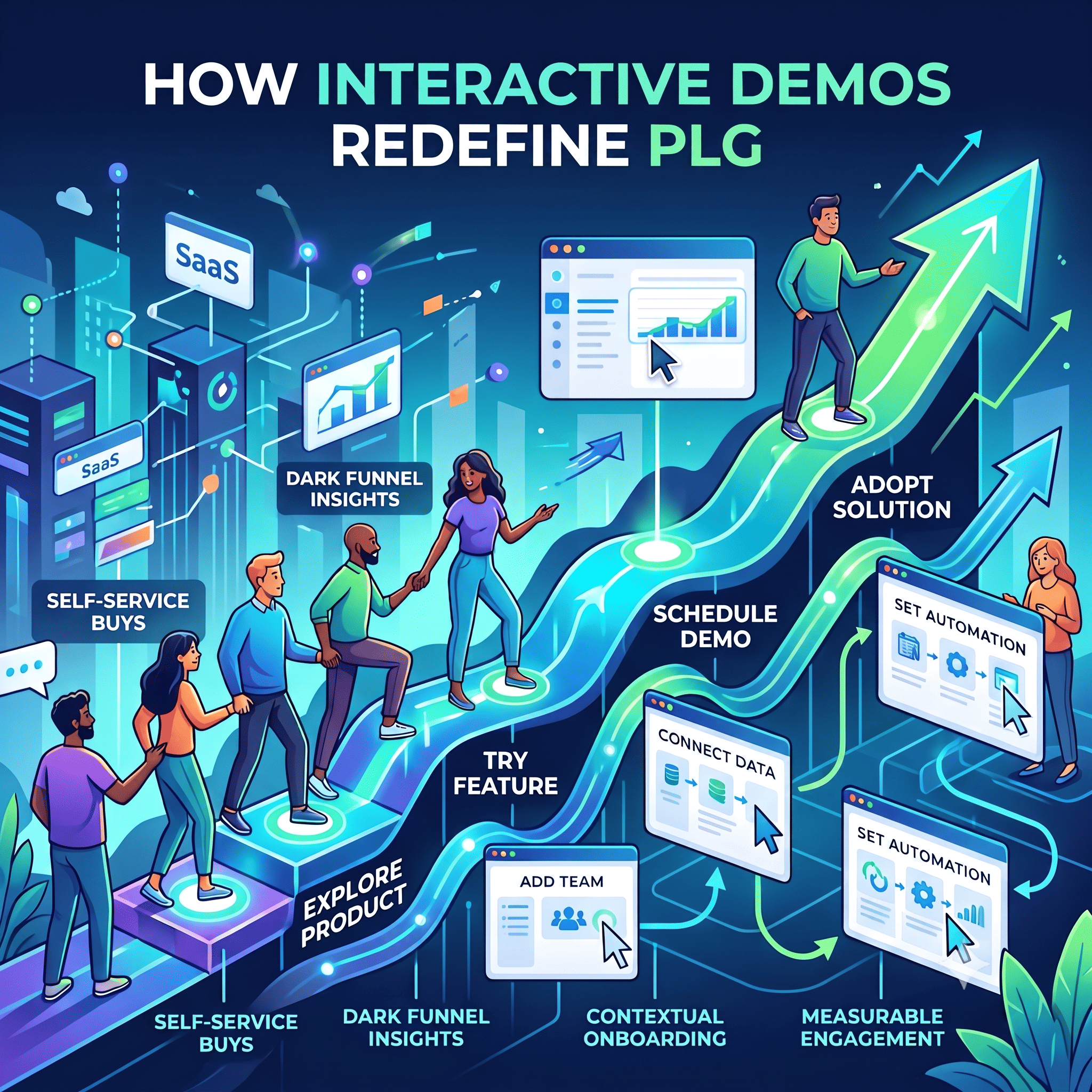
In 2026, the way SaaS companies think of Product-Led Growth goes beyond free trials and freemium models. They no longer meet the expectations of what self-serve means to modern buyers. Let’s say the prospect signs up for a free trial and has no idea what to do next. That’s where free trials and freemium models quietly fail. But with interactive demos, users are sequentially guided on what to do next.
B2BSaaS companies are now investing more in interactive product demos that offer self-service to customers before the sales team comes into the picture. But investment isn’t the same as results. The gap between implementing a PLG and making it work is bridged by interactive demos. The problem that today’s buyers face isn’t finding the correct product that serves them; it’s deciding on one product that’s worth it. The modern trend in B2B purchasing is that buyers want to experience the software immediately without overwhelming installation steps, committing to sign-up forms, or lengthy onboarding processes.
For the past few decades, a “demo” meant a scheduled call with a sales rep or a sales-rep-led screen share. That model is no longer how buyers evaluate a product. Now, only after the final decision does the buyer come into direct contact with the salesperson. The decision-making process happens independently. Interactive demos play a major role in assisting buyers with their final decision.
Interactive demos aren’t just confined to the product page. Leading SaaS companies are embedding interactive demos throughout the buyer journey. Interactive demos are embedded on marketing pages, onboarding flows, home pages, and feature pages. With tools like Floik, you can create interactive demos and customize them with advanced built-in editing tools. A well-built interactive demo can significantly improve sales and product adoption.
A common misconception is that interactive demos are intended to serve only prospective customers evaluating the product for the first time. But this is just one of the primary use cases. Interactive demos serve multiple audiences, including prospective buyers, Sales teams, Marketing teams, Customer success and onboarding teams, and existing customers.
Another important trend is the dark funnel. Organizations are often not aware of how buyers find their products, because nowadays it’s not a linear path anymore. They may have discovered your product through a LinkedIn post, community discussion, AI search engines, or recommendations from colleagues. An Interactive demo works best in this case, because an interactive demo can be shared anywhere. The buying committee need not wait for a call scheduled with the sales committee; they can experience the demo at their own pace.
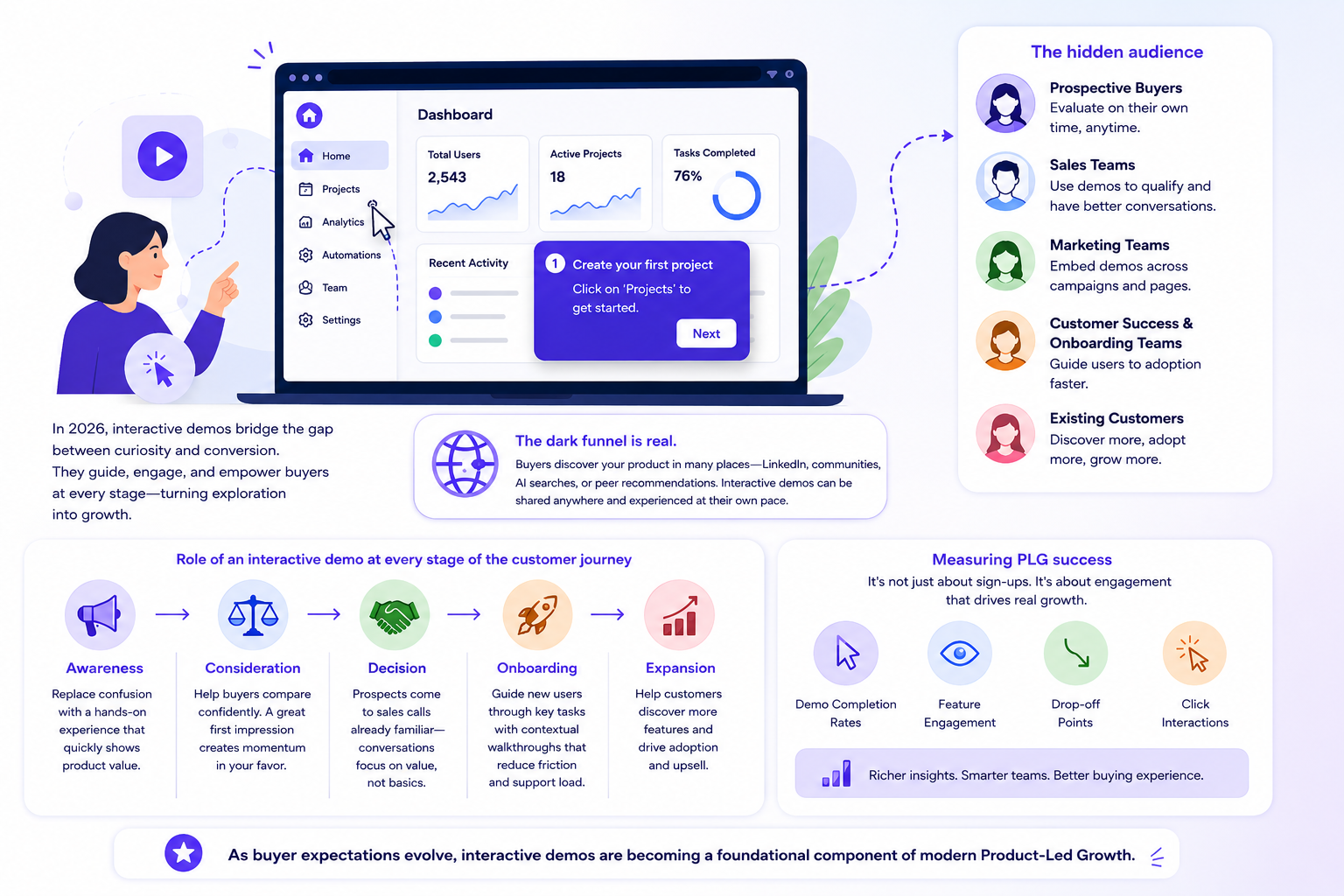
Image generated by ChatGPT (OpenAI, 2026)
For years, organizations treated interactive demos as assets to be placed on landing pages to boost conversion rates. While that’s true, interactive demos play a much more important role throughout the customer journey.
Awareness
When a customer lands on your website from a blog post or LinkedIn post, they do not have the patience to discover what makes your product unique. An interactive demo replaces that confusion with a hands-on experience and makes it easier for the customer to decide whether the product is worth it. An interactive demo creates a small dopamine hit of accomplishment as the customers perform the actions themselves that a static screenshot or videocouldn’t.
Consideration
An interactive demo plays an important role in the first impression. Let’s say the customer is comparing three products to choose from. When your product offers them a hands-on experience that creates momentum, there is a higher chance the customer considers your product over the other products.
Decision
After exploring the product through an interactive demo, when the prospect finally reaches the sales rep, the prospect already knows the product. Therefore, during the call, instead of focusing on basic workflow, the sales rep can answer business-specific questions. This helps conversion at a higher rate because they are addressing real objections rather than basic workflows.
Onboarding
The role of the interactive demo doesn’t stop after the deal is closed. The purpose of the demo now shifts from marketing to guiding the customers through a smoother onboarding. The demos become a contextual walkthrough for new users. Interactive demos for tasks such as connecting their first data source, adding a team member, and setting up automations can be placed in the onboarding journey. This reduces the load on support and CS teams, especially during the highest friction period of the relationship.
Expansion
Sometimes the customers adopt the two or three core features and never discover the rest of the features in the product. In these cases, an interactive demo for those unused features can be embedded in-app or sent via lifecycle emails. Therefore, interactive demos make feature discovery easier through guided walkthroughs for new features, which creates an opportunity for upselling.
Most companies measure the success of Product-Led Growth through sign-ups or trial activations. However, a user creating an account doesn’t necessarily mean that they will buy the service. What matters is how much they engage with the product.
Interactive demos provide richer engagement signals than traditional landing pages. With interactive demos, teams can measure metrics such as demo completion rates, feature engagement, drop-offpoints, and click interactions. These insights help product and sales teams improve the buying experience.
As the expectations of buyers evolve, interactive demos are becoming a foundational component of modern Product-Led Growth.


.avif)
.avif)
.avif)
.avif)
.avif)
.avif)
.avif)



.avif)



.avif)