Celebrate July 4th with a 10% Independence Day discount! Use coupon code — JULY4QC2024! 🤩
-p-130x130q80.avif)

.svg)


As a SaaS provider, you would have come across this thought at some point: Though the product is good, why do most trial users never really become paying customers? The problem is not with the product. It is the experience that it provides. Maybe during the trial, the users never truly experience the product’s value. The users never encounter the moment of magic. They did not connect to the product, got confused. The trial ended and they moved on.
The gap between trying the product and trusting the product is what Product-Led Growth aims to solve. The product must sell itself; this is where interactive demos make it achievable. In this blog, we will break down how an interactive demo becomes a game changer in converting trial users to paying customers.
Between the sign-up and the trial period, the product must impress the user. The conversion rate depends on how the user feels during this period. The user might not end up as a customer due to the following factors:
Lack of clarity: The users fail to understand what solution the product provides or how it helps them to solve a problem.
No guided path: Most users abandon trials as they do not get enough contextual guidance. Users are left to explore the product themselves. This leads to missing out on what really matters.
Delayed value realization: The trial period expires before the user discovers the feature that would have made them pay.
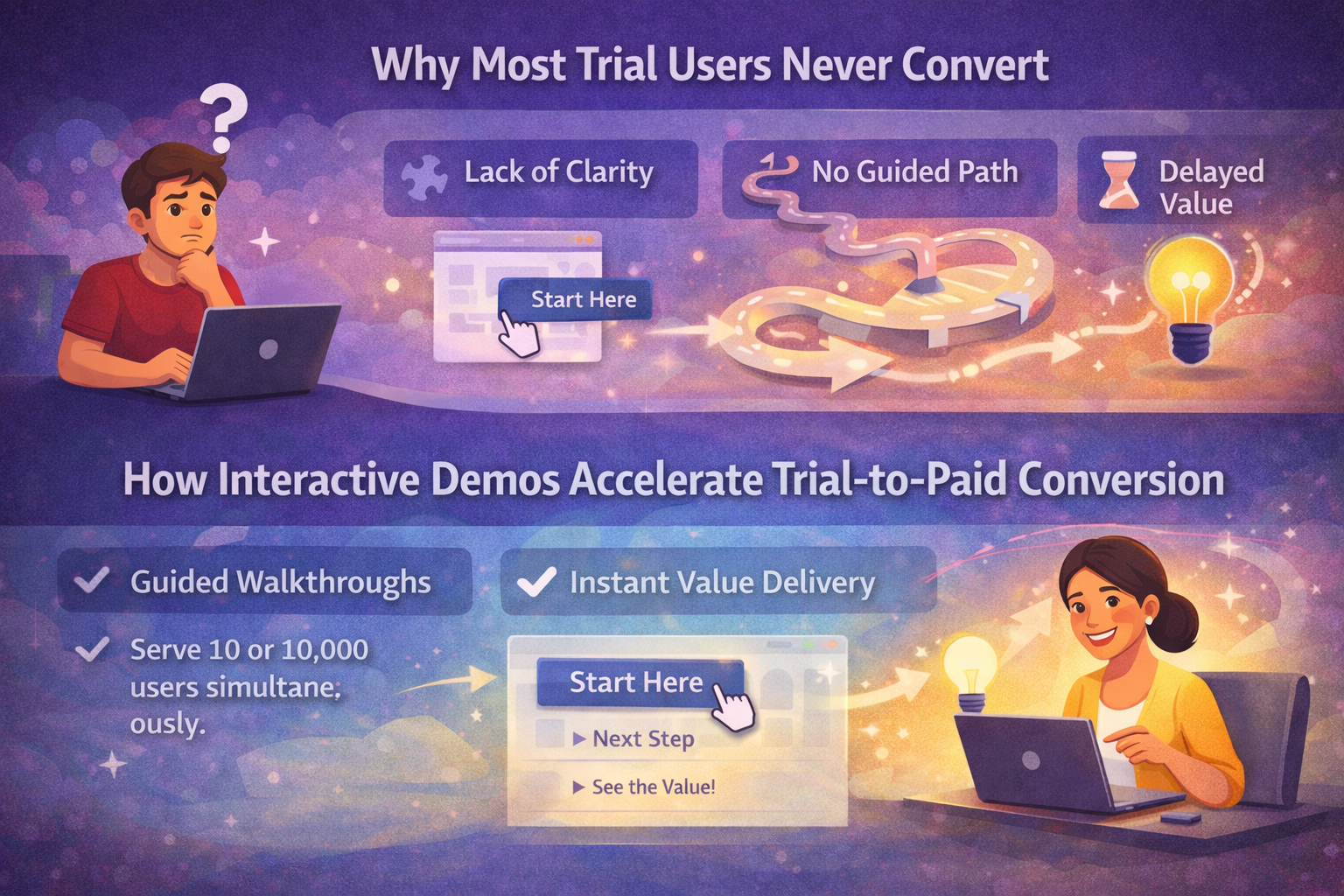
Image generated by ChatGPT (OpenAI, 2026)
An interactive demo is not just a product tour or product walkthrough. They change the way the users experience the product. It is a clickable, self-paced experience – providing structured and intuitive guidance.
Guided walkthroughs: A new interface would make the user feel overwhelmed. Interactive demos break it down into clear, step-by-step interactions through high-value features.
Instant value delivery: Interactive demos focus on showing users the outcome. It lets users experience the product value within minutes – showing how the product serves as a solution.
Active engagement: Interactive demos provide hands-on experience. Unlike videos or documentation, an interactive demo requires active participation – creating strong product memory.
By showing users exactly what to do, how to do it, and why it matters, the product itself becomes a driving factor for conversion.
Let’s understand how interactive demos impact user behavior.
Without interactive demos, a user signs up. Lands on the dashboard. The product has a number of features. The user is unsure where to start. They click around randomly, try a few things, and eventually lose direction. Before the product clicks for their use case, the trial ends and they never reach out again.
Now, let’s describe the same scenario with interactive demos. The user signs up. But this time they are guided from the very first screen they land on. They get a step-by-step interactive tour for every key action. Within minutes, they have done something meaningful within the product. They understand what problem the product solves and why it might help them.
This provides contextual clarity to the user, instead of leaving them in a confused state. This experience is what converts a user to a customer.
Unlike traditional sales approaches, interactive demos don’t require manual intervention. Once demos are set up, they operate continuously. Whether you have 10 or 10,000 trial users, a standard interactive demo would provide the same level of clarity to each one of them.
This scalability provides significant benefits.
Always available: Interactive demos eliminate the dependency on sales rep’s availability for product walkthrough. Interactive demos are available 24/7 – acting as a sales engine.
Parallel user onboarding: Thousands of users can be served simultaneously without compromising the quality of experience.
Better sales focus: Tracking the clicks and drop-off points in demos can improve sales. They can focus on analyzing these insights to improve the product experience.
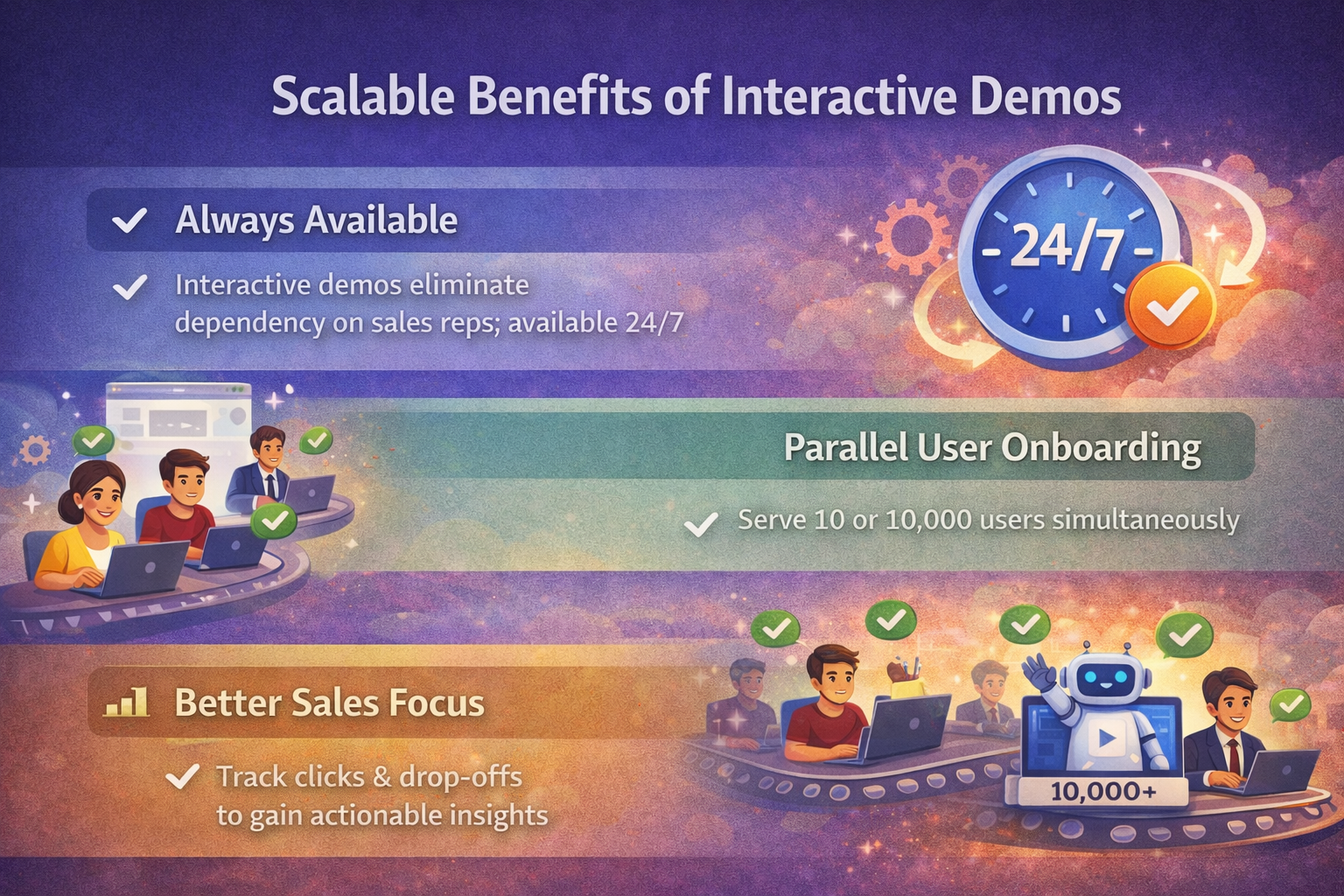
Designing a well-defined demo strategy drives users to reach the key activation point as quickly as possible.
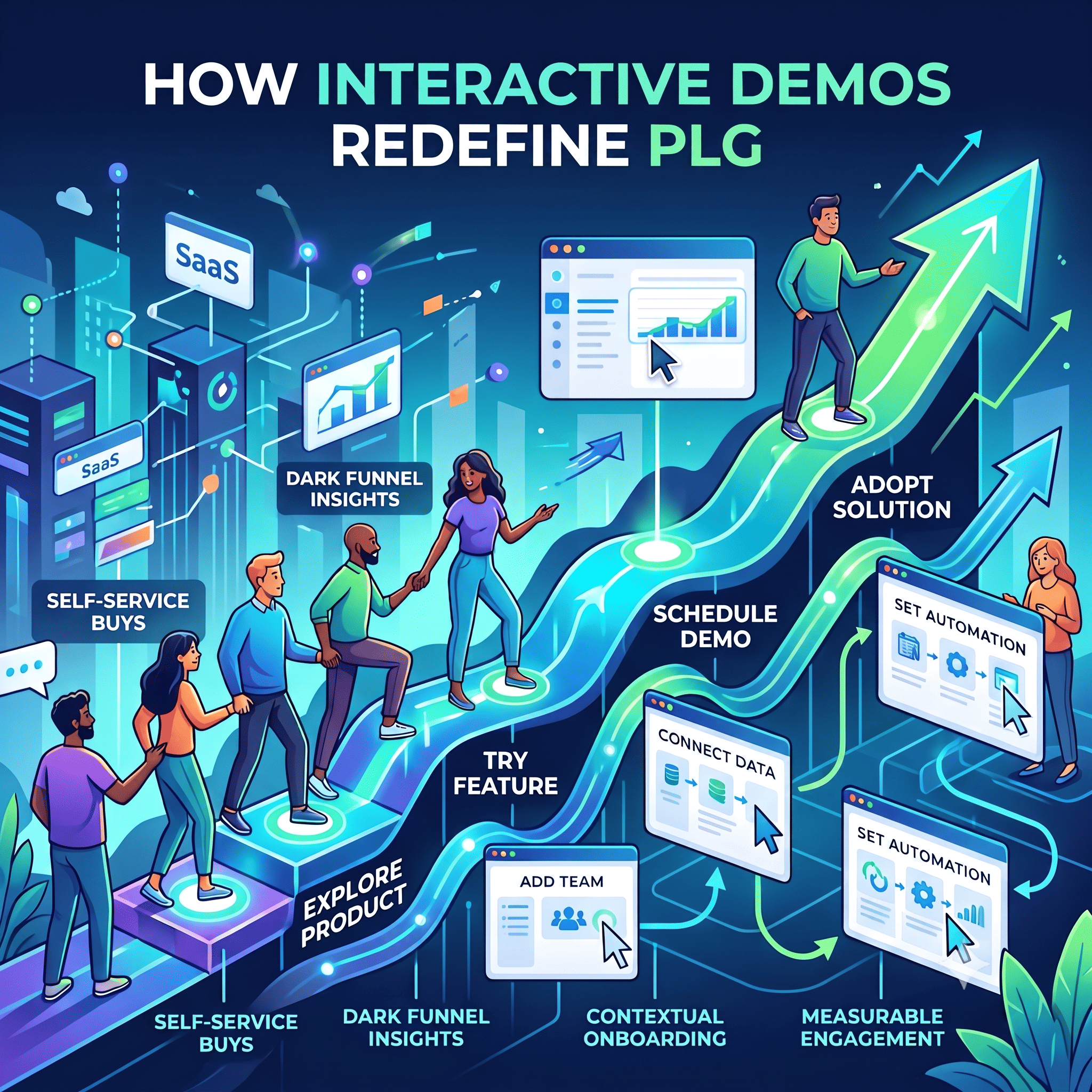
In the era of Product-Led Growth, a company wins when the product speaks for itself. Demonstrating the product is as important as creating it. With tools like Floik, you can build an interactive demo in minutes. Your interactive demo is the first product experience your users will ever have. Make it count.

.avif)
.avif)
.avif)
.avif)
.avif)
.avif)
.avif)



.avif)




.avif)