Celebrate July 4th with a 10% Independence Day discount! Use coupon code — JULY4QC2024! 🤩
-p-130x130q80.avif)

.svg)


Somewhere right now, a prospect might be discovering your product without your sales team introducing it to them. They are evaluating your product on their own. No sales rep on the call, no discovery questions, no one to explain what problem your product solves. Just the prospect, your website, documentation, interactive demos, videos, customer stories, and other resources you have set up for them to explore.
What has been described above is not a hypothetical scenario; that’s today’s reality of how B2B buyers' journey begins. Buyers compare vendors and even shortlist solutions even before they book a single meeting. This shift has transformed the role of sales enablement.
A decade ago, buyers were dependent on sales reps to understand the product’s capabilities. Sales enablement meant a content repository. However, it rarely addresses the questions that customers have.
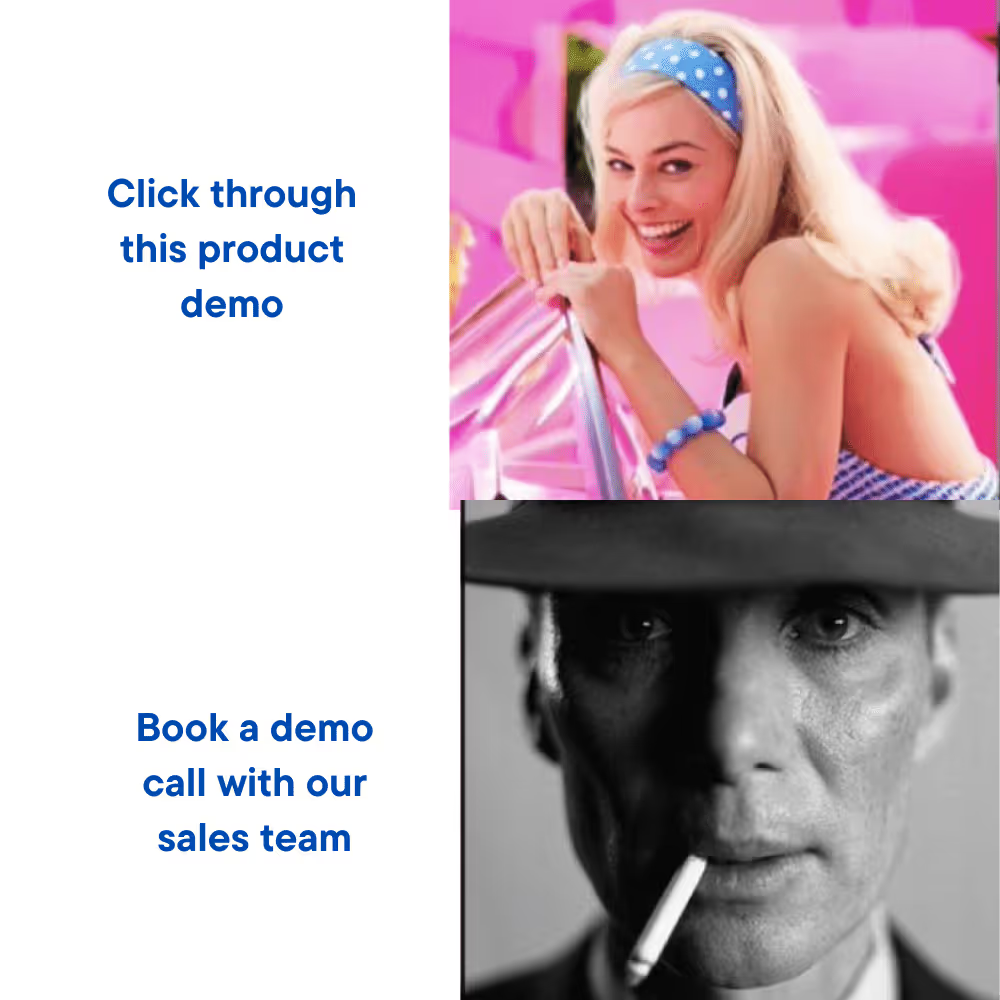
Imagine a prospect is evaluating a workflow automation platform. They have two options: either reach out to the sales team, wait for a response, and book a call when both the sales team and the prospect are free, or the moment they land on your website, the prospect can click through and explore the product interface themselves without even having to sign up. Today’s buyers’ ideal choice is to explore the product on their own. This preference explains why interactive product demos have become increasingly common in SaaS companies.
For years, sales enablement was primarily focused on equipping sales representatives with all the resources they need to close a deal. Case studies, pitch decks, battle cards, product brochures, and sales scripts are considered the backbone of most sales enablement strategies.
This approach worked when a discovery call was the first meaningful interaction between a prospect and a software vendor. The sales rep guided the buyer throughout each stage of the journey and shaped the evaluation process from the beginning.
However, today the buyer journey looks very different. As discussed earlier, most of the evaluation happens independently without relying on the sales team. By the time the prospect books a demo, they are aware of what the product does. This fundamentally changes the role of sales enablement.
In addition to the traditional sales enablement strategy of preparing the sales team with resources and knowledge, the enablement teams are now responsible for creating a buyer experience that supports prospects throughout their independent research journey.
Each customer-facing asset, such as a product demo, knowledge base article, implementation guide, pricing page, feature page, and customer success story, becomes a part of sales enablement.
For a high-performing SaaS organization, sales enablement needs different tools at different stages of the buyer’sjourney.
Each tool serves various purposes. Some help the sales team find and share the right content, some others help the buyer experience, while others provide insights into what’s working and where the deals get stuck. Together, these tools create a seamless experience for both sales teams and buyers.
1. Content management platforms for sales
When assets are scattered across emails, shared drives, team messages, and personal folders, sales reps spend a reasonable amount of time finding information compared to the time they spend selling the product. Therefore, sales teams waste time searching for information instead of focusing on valuable conversations with clients.
A centralized sales management platform can fix this. These platforms let sales teams quickly findup-to-date information. Additionally, modern platforms provide insights into how the content is used; this helps refine the content strategy that influences buying decisions.
2. Sales readiness and training platforms
Training the reps on behaviors tied to revenue outcomes is an inevitable part of sales enablement. If a sales rep doesn’t know when to use which sales asset to close a deal, sales will not improve regardless of having the best content management system.
Sales readiness platforms help onboard new hires, deliver continuous product education, and prepare teams for new product launches. Training the reps ensures that every rep receives accurate information, understands the impact of each sales asset, and can confidently present the product to clients and address their questions.
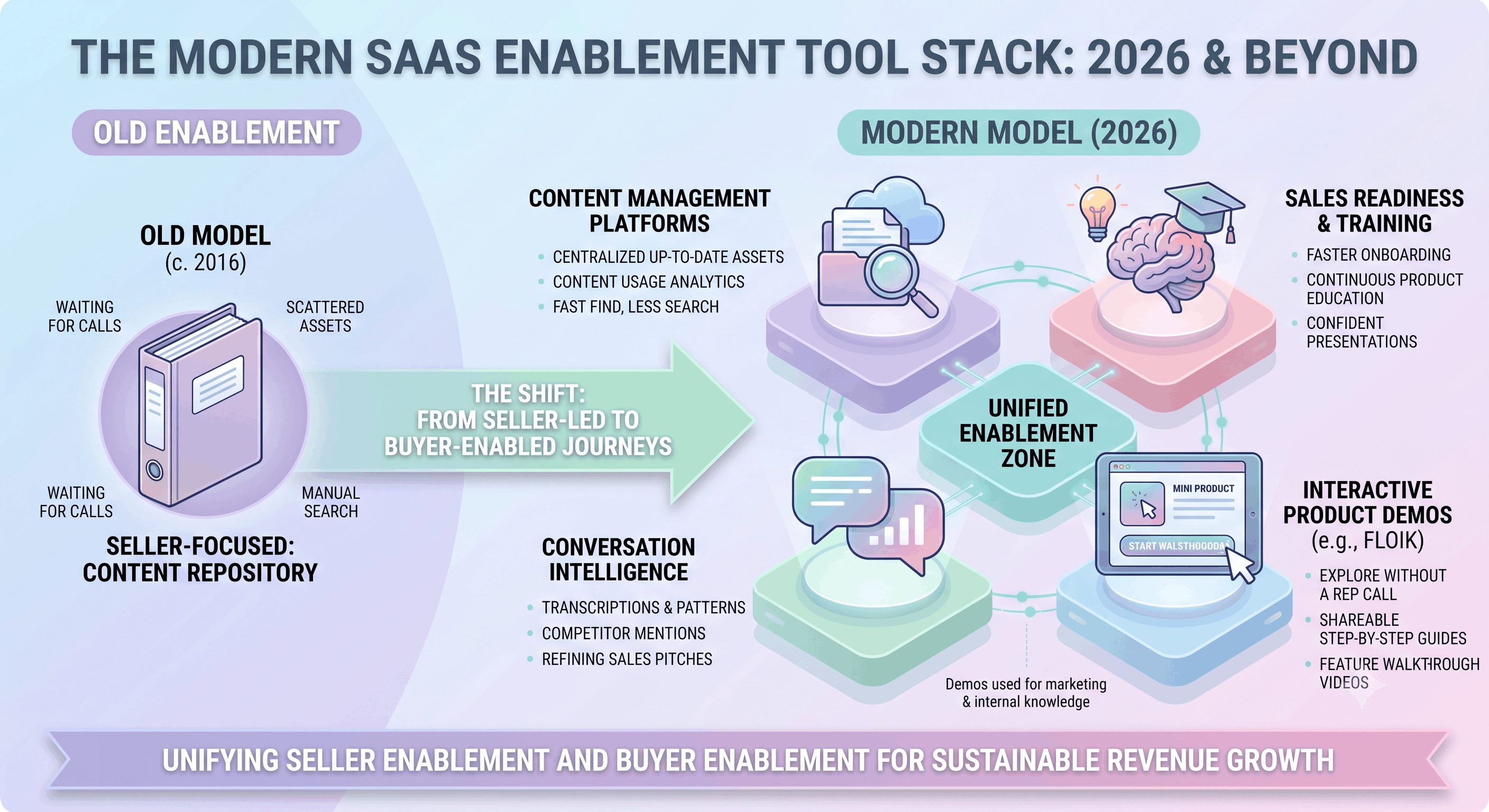
Image generated by Google Gemini (2026)
3. Conversation intelligence platforms
Every interaction with the client is a valuable sales asset. They provide valuable insights into clients’ expectations and experiences, which competitors they mention, and where a rep goesoff-script.
Conversation intelligence platforms record, transcribe, and analyze customer conversations. For sales enablement teams, this helps prioritize content based on real conversations across the sales organization.
4. Interactive product demo platforms
Interactive demos address something the other three tools don’t: content management, sales readiness, and conversation tools are associated with making the reps better. None of them deal with buyers’ experience.
Interactive demos fill this gap, helping buyers try out the product without needing a call with the sales rep.
This is where platforms like Floik come into sales enablement strategy. Beyond creating interactive demos, enablement teams can create shareable step-by-step product guides and feature walkthrough videos that support buyers throughout their evaluation process.
Sales enablement in 2026 is no longer measured by how knowledgeable your sales team is – it’s measured by the friction between a buyer and the answer they are looking for, irrespective of the availability of a rep. A content management platform organizes sales assets, a readiness program makes reps confident, conversation intelligence tools reveal patterns from customer conversations, and interactive product demos allow buyers to experience the product on their own terms.
Organizations that invest in both seller enablement and buyer enablement will drive sustainable revenue growth. Products like Floik complement this strategy as the demos created using it can be used as an internal knowledge resource as well as a marketing asset.













.avif)




.avif)
.avif)
.avif)
.avif)
.avif)
.avif)


.avif)
.avif)
.avif)


.avif)

.avif)