As of 2026, SaaS adoption is nearly universal. The global SaaS market is growing at a rate of 13.3% each year and it is expected to hit $1.25 trillion by 2034. While products go global, so do demos and documentation. Yet most SaaS companies still have English-only product demos which may limit the global reach of their product.
As the product is used by people across the globe, users from each region expect the product to be in their native language and cultural frame of reference. If not, adoption drops and support tickets rise – affecting product growth.
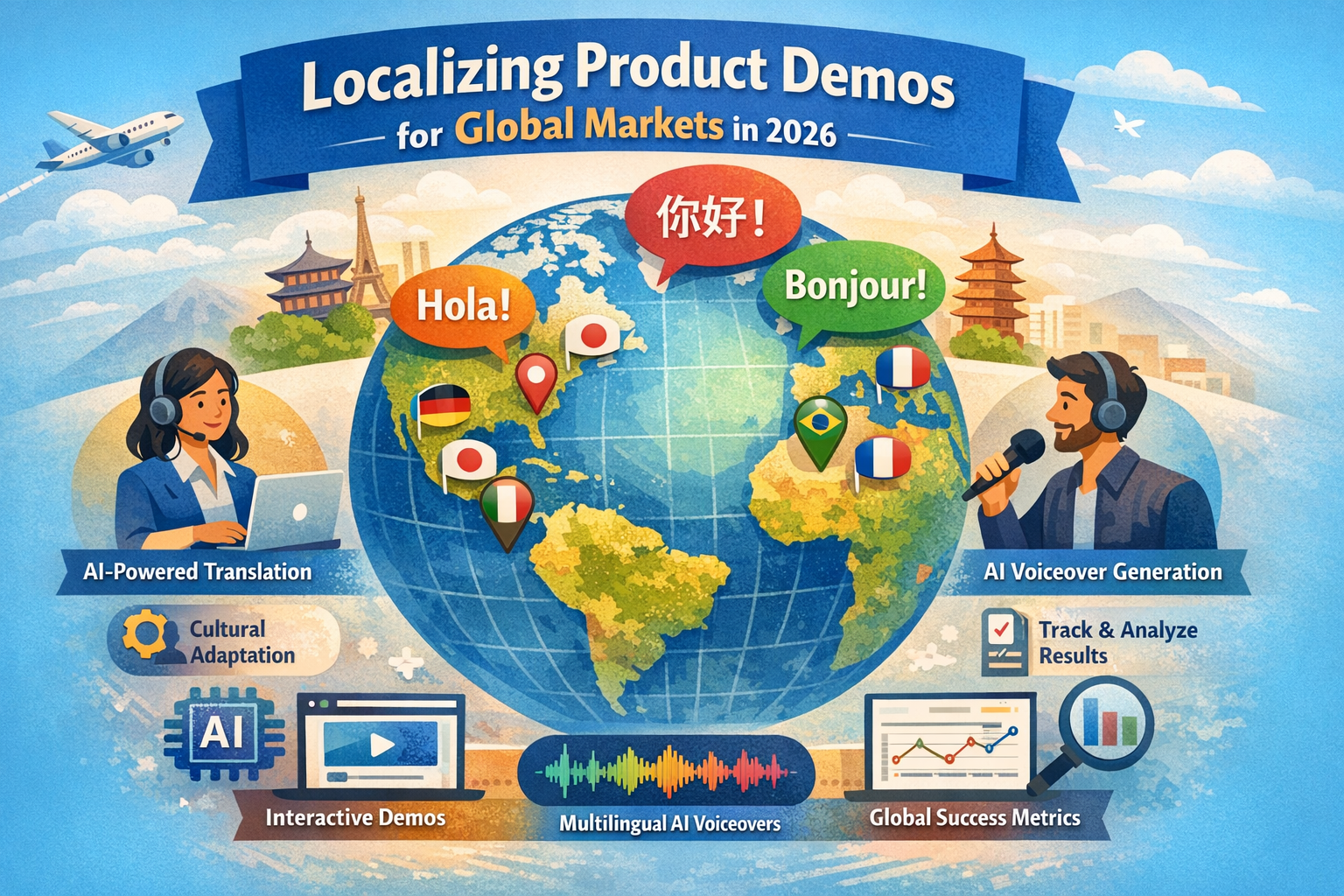
So, how to meet the needs of a global audience? The ideal solution would be to localize product demos for global markets. In this article, we’ll explore how to localize demos for SaaS products, best tools for demo localization, and how AI contributes to scale multilingual product demos.
Why product demo localization matters in 2026
Users may find it difficult to understand the product when the demos are not in their language. As an organization, you are responsible for ensuring that your product demos are accessible to users globally. That being said, product demo localization is not an option in today’s market. It’s a strategy for global product expansion.
Localizing product demos does not only deal with language. It has measurable business outcomes.
High user adoption – When users find demos in their native language, it’s easier to follow and understand. This increases adoption.
Better engagement – Users engage more when the interactive demos are in their native language. Videos, where the narration and text coordinate with the user’s language, create an intuitive experience than any other language.
Reduced support load – Confusion leads to support tickets. Localized demos provide a clear understanding to the users. This reduces the support tickets received.
Localize product demos for global markets
Following a structured approach while localizing product demos will ensure that your investment drives revenue and product adoption globally.
High-impact markets We can’t just translate a demo into 10 random languages and call it a localized one. Start by identifying the traffic by geography, reviewing product sign-ups by region, support tickets and user demands by language, and finding emerging markets. With this data, decide the languages to which the demo needs to be translated.
Localization scope The demo should feel more native than just translated. While translating, change the voiceovers, way of narration, on-screen text, and subtitles, not solely the language. Clarity and precision matter more than raw translation when it comes to localization.
Translate and adapt content Once the high-impact market and scope for localization is defined, adapt the script and refine tones carefully such that it fits the cultural expectations. Avoid using regional phrases that cause confusion while translating. Replace region-specific examples with generic ones.
Scale localization with AI Manually recreating demos for each language is expensive and it requires more manpower as well as time. Use AI-integrated tools that make localization fast. Create product demos in one language and use AI assistance to adapt them across languages.
Consistency across languages Localization is not a one-time task. Every update in the product, UI change, or feature launch triggers a localization update. Always keep the demos updated across languages.
Test with native users Before publishing the demos, conduct testing in each target region. Ensure that the clarity and tone match. Check for any cultural mismatches from regional user feedback.
Measure impact After publishing the localized demo, keep track of demo completion rate, support ticket, and product adoption by region. If you notice measurable improvements after localizing, then you are on the right path.
Role of AI in scaling multilingual product demos
As mentioned earlier in this article, translating demos manually to each language is slow and expensive. AI assists in faster and context-aware translations.
AI-Powered Translation Traditional translation involves repeated recording and revisions at each stage of product growth. With tools that have AI-powered translation, teams can convert product demos from one language into multiple languages instantly.
AI voiceover generation Voiceover is the most time-consuming task in traditional translation. AI-generated voiceovers overcome this by allowing teams to generate natural-sounding narration and instantly regenerating voiceovers when scripts are updated. All these can be done parallelly across multiple languages with the help of AI.
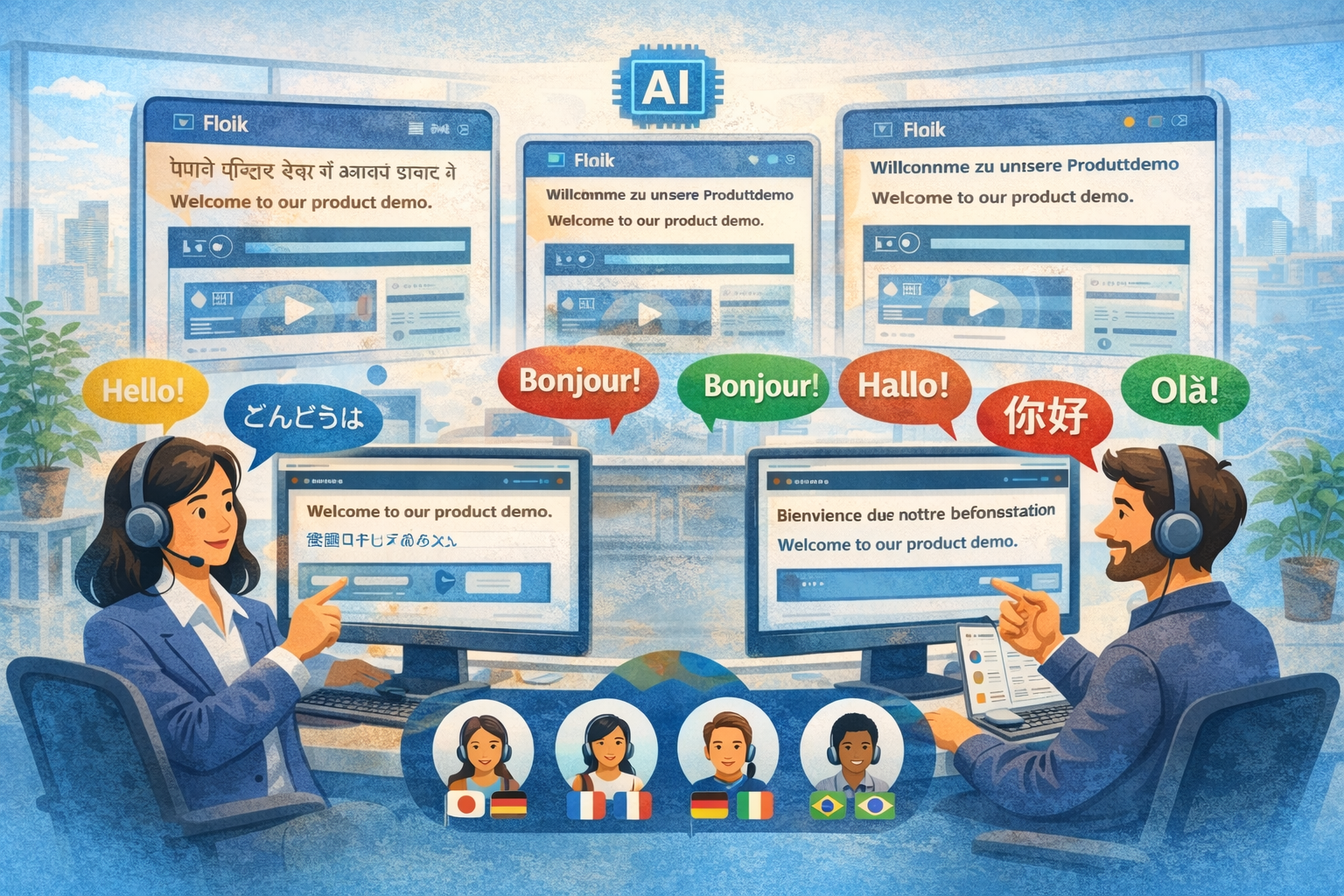
Multilingual AI voiceovers with native accents While translating demos, it’s important not to miss out regional accents. User trust builds faster when the demo feels familiar. Floik supports multilingual AI voiceovers. You can localize your demo with 20+ AI voices providing region-specific accents. Floik keeps voiceovers perfectly synced with on-screen interactions.
With this demand for multilingual product demos, there are many tools like Floik - providing AI assistance to create multilingual demos. Use those tools and take product localization to the next level. Shift from English-only demos to multilingual demos isn’t optional, it’s the next step that truly impacts product adoption, revenue, and customer experience.
-p-130x130q80.avif)

.svg)














.avif)




.avif)
.avif)
.avif)
.avif)

.avif)
.avif)

.avif)
.avif)
.avif)

.avif)
.avif)